

Devlog · [date] · Nic
Under the hood: simulating a still run
Last time I said Still House tracks the real chemistry of every run. This post is for anyone who wants to know what that actually means. It gets nerdy. That's the point.
What a pot still does
A pot still is a kettle with ambitions. You charge it with a weak, beery liquid (in our model, around 28% ABV for a spirit run), heat it, and collect what boils off.
The vapour is richer in alcohol than the liquid it came from, because ethanol is more volatile than water. But as the run goes on, the pot loses alcohol faster than water, so the vapour gets weaker too. That's why the proof off the still starts high and falls through the run.
The game models this the way a chemical engineer would: as a Rayleigh distillation, stepping the pot forward in time and working out, at every step, what the vapour in equilibrium with the pot liquid looks like. A real pot still isn't a perfect single stage. Some vapour condenses in the head and runs back down, which adds a little extra separation. We treat a pot still as about 1.2 equilibrium stages.
The result has the shape real distillers know: the spirit comes off in the high 70s, declines steadily through the hearts, hits a knee around 60%, then falls away fast and trails off to about 1%.
Congeners: the part that tastes of something
If spirit were only ethanol and water, it would taste of nothing. The flavour comes from congeners, trace compounds made during fermentation: esters that taste fruity, fusel alcohols that taste heavy and oily, aldehydes that taste green or solventy, acids, and a long tail of others.
Still House tracks 29 of them. Each one has its own volatility relative to ethanol, which decides when in the run it comes over. We calculate those volatilities from physical chemistry (activity coefficients from the UNIFAC-Dortmund model, and vapour pressures at the still's temperature), then sanity-check them against published data. Ethanol's own value lands within 2% of the standard engineering reference.
That's why cuts matter. Ethyl acetate, the nail-polish-remover note, comes over early, so it's concentrated in the heads. In our model, a hearts cut that throws away 2% of the run as heads leaves 39 g of ethyl acetate per hectolitre of pure alcohol; throw away 4% and it drops to 27.5. Heavier compounds, like the rose-scented 2-phenylethanol, pile up late, in the tails. Where you cut is a choice about flavour, not just yield.
Running it hot or slow
How hard you fire the still changes how much reflux you get, and so how cleanly it separates. Run it gently and you get a bigger, cleaner hearts cut, but the run takes much longer. In one test, half heat gave a hearts share of about 78% of the charge's alcohol in 296 seconds of game time; full heat gave 65.5% in 176 seconds.
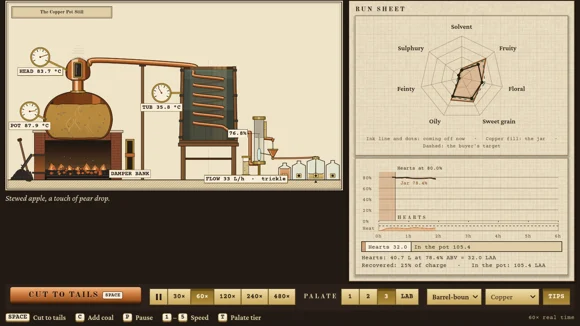
Low and slow
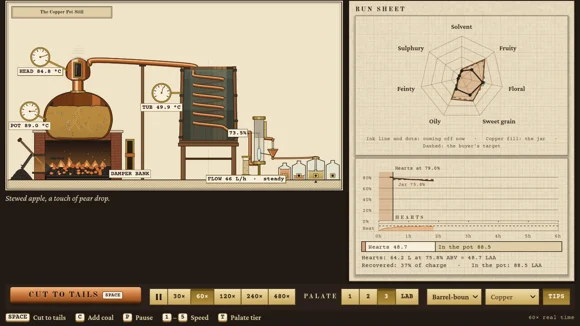
Standard
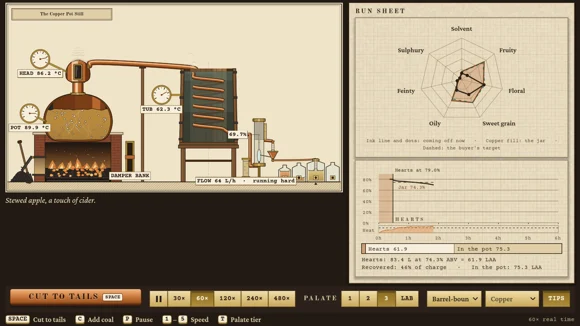
Hard and fast
Slow wins per batch. Hard wins per hour of still time. That trade-off is the heart of the business game later: a craft decision on the run screen becomes a scheduling decision on the calendar.
From chemistry to flavour
You never see “ethyl acetate: 39 g/hL AA” during a run. At least, not at first. We turn the chemistry into what a distiller would perceive: each compound's concentration is compared with its sensory threshold, rolled up into flavour families (fruity, floral, solvent, sweet grain, oily, feinty, sulphury) and then into specific notes like pear or pineapple.
Early on, your tasting wheel groups things broadly, like a new palate does. As you progress, it splits into finer notes, and late-game lab equipment reveals the actual compound readouts.
What we simplify (for now)
This is a simulation, not a refinery. Honest list:
- Pot stills are modelled as a small, fixed number of equilibrium stages, not plate by plate. Columns will get proper plates later.
- Some compounds are made or changed in the still itself (copper reacting with sulphur compounds, for example). Those formation effects are coming; for now a few compounds use tuned curves instead of pure physics.
- Some of the equilibrium maths uses approximations we plan to tighten, like working in volume rather than mole fractions in places.
If you know this stuff and something looks wrong, tell us: nburton@hohmanngames.com. Getting it right is half the fun.
If Still House sounds like your kind of game: